

How To Clean My Speed Queen Washing Machine
Washing Automobile Repair
Affiliate 8
SPEED QUEEN / AMANA
WASHING MACHINES
NOTE: Chapter ii covers issues common to almost all washer designs.
THIS affiliate covers merely diagnosis and repairs peculiar to late
model Speed Queen / Amana-designed washing machines.
If you do not read Chapter 2 thoroughly before you read this chapter,
yous probably will not be able to properly diagnose your machine!!!!
Speed Queen washing machine has undergone several major design changes in the by few years. Parts for the erstwhile (pre-1980) fluid drive machines are generally not available anymore, and they are no longer economical to repair, so they are no longer included in this manual. If you have i of these fluid-bulldoze machines, you'd all-time be thinking about getting a new machine.
Raytheon / Amana is notorious for making several design changes even within a single model year. When ordering or buying parts, it is wise to bring with you the product number, found on the nameplate forth with the model number. Might save yous a trip.
Even among the new style washing machines, there have already been ii MAJOR design changes. Within the tub, they went from the old-fashion agitator post and drive block (similar to those found on the old fluid drive machines) to a curt-shaft air-bell agitator connection. (Run across section eight-5) Later, they went from a pump driven past a 2nd chugalug to one mounted directly on the drive motor.
8-1 BASIC OPERATING SYSTEMS
Late model washing machines have a directly-reversing motor, and the transmission is belt-driven directly off a motor pulley. (Figure SN-1) Until the early 'ninety'southward they used a 2nd chugalug to drive the pump; these are unremarkably referred to in the parts stores equally "two-belt" machines. Subsequently that, the pump was driven straight off the bottom finish of the motor shaft; these are commonly referred to as "straight bulldoze" washing machines. There is but 1 belt in direct drive machines.
Figure SN-1: Late Model Bulldoze Train
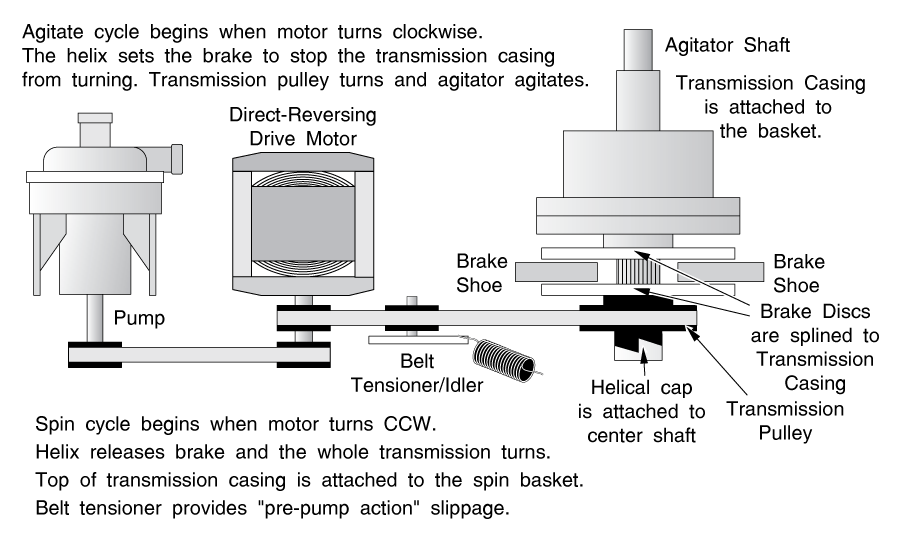
The top of the transmission casing is connected to the basket, and during the spin bicycle, the whole transmission rotates. Slippage in the belt, allowed past the tensioner, permits a "pre-pump" action, allowing the basket to come slowly up to speed.
The bottom of the transmission casing is connected to a restriction. This brake is activated by a helix in the hub of the transmission caster. During the agitate cycle, the restriction engages and prevents the manual casing (and thus the basket) from turning. During the spin bicycle, the helix mechanism releases the brake and the whole transmission spins around.
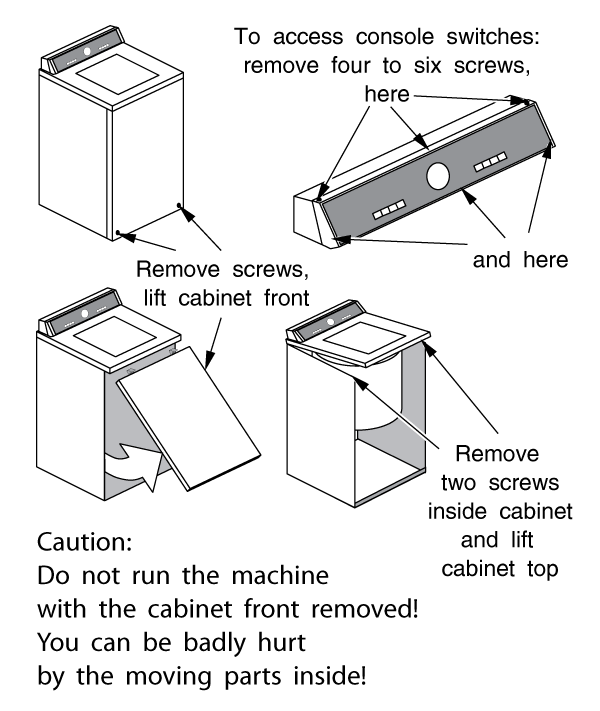
8-2 OPENING THE CABINET AND Console
The console or cabinet may be opened every bit shown in effigy SN-2.
Effigy SN-2: Opening the Chiffonier and Console
CONSOLE SWITCHES
The timer knob simply unscrews from the timer shaft. About other knobs pull directly off their D-shaped shafts. The timer and most other switches tin then be removed by opening the panel and removing the switches' terminals and advisable mounting screws or nuts.
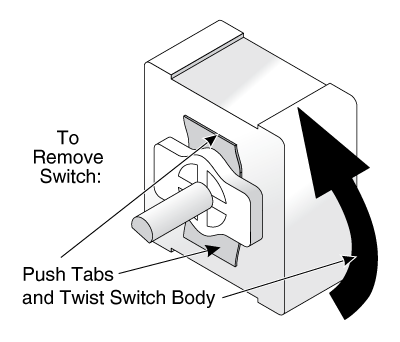
However, some switches on belatedly model machines are different. To remove them from the console, you must printing on the locking tabs adjacent to the shaft (figure SN-iii) and twist the whole switch counterclockwise.
Figure SN-3: Late Model Switch Mounting
8-3 WHAT TYPICALLY GOES Incorrect WITH THESE WASHING MACHINES
The near common problems with these washers are:
SYMPTOM: WATER LEAKS
In "short shaft" machines (late model machines with a drive bell; meet section viii-5) the center tub seal starts leaking. To repair or replace, see section 8-6.
Some other source of water on the flooring is pump leaks. To supersede, see section 8-iv.
The basket may be spinning during agitation. This will sling water over the top edge of the tub and appear to be a water leak. Replace the brake pads as described in department 8-seven.
SYMPTOM: NOISY OPERATION
In my opinion, these machines operate a little noisily to begin with. Nonetheless, if they seem a little noisier than usual, bank check your belt(s). The sound is difficult to describe; it'southward kind of a "thunk-thunk-thunk." It happens when the belt has a few chunks taken out of it; the belt tensioner/idler starts "bouncing." To check and supplant the belt, meet section viii-four.
A "knocking" sound during agitation may be a worn drive block. Encounter section 8-6.
SYMPTOM: OIL IN THE CLOTHES
If oil starts showing upwardly in the clothes, what has usually happened is that the top manual seal has deteriorated and is letting water into the transmission casing. The water displaces the oil and forces it out through the seal and into the clothes.
If you want to keep the machine, the manual must be replaced. This is a difficult and expensive repair, oft costing more than 200 dollars just for parts. Y'all may want to price out the job before you start and decide whether it might exist more worthwhile to only replace the auto. You might also cheque out the availability of a rebuilt manual. Come across section viii-7.
SYMPTOM: NO AGITATE, OR NO SPIN
This is usually a broken manual drive chugalug. (Section 8-iv) It could besides be a lacking drive motor. (Section ii-six(e)) or a siezed pump, preventing the motor from turning.
eight-4 PUMPS AND Belt Changing
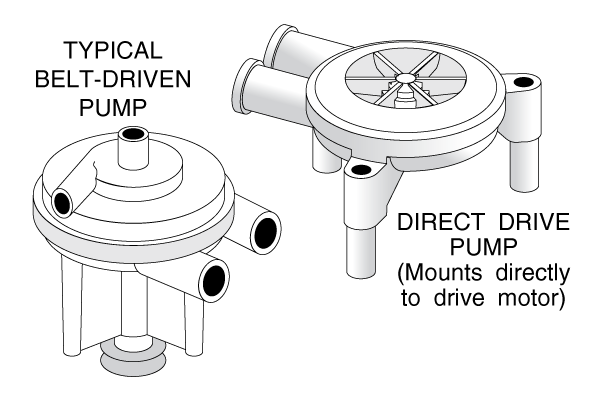
(Figure SN-4)
Pumps in the belatedly model machines cannot exist rebuilt. They must exist replaced if leaking or defective.
Ii-BELT MACHINES
Belt driven pumps are replaced by simply removing the pump mounts.
Tension is kept on the pump belt by adjustment. Tension is kept on the manual belt by an idler pulley. There is a kit bachelor from your parts dealer with a new belt and idler and instructions on how to adjust the belt.
Effigy SN-4: Pumps
In two-belt machines, you can suit the pump belt by loosening the pump mounting plate bolts and moving the pump until you have near 1/2-inch deflection with moderate finger pressure (well-nigh 1 to ii pounds.)
DIRECT Bulldoze MACHINES
Pump or belt irresolute on a direct drive auto is a little trickier. To do either the pump or belt, yous must remove the motor platform. Starting time, unplug the motor electrical harness cake from the motor. Release belt tension by slipping the belt off the transmission pulley. Disconnect the hoses from the pump. (H2o will run out, and so accept a towel handy!) You can then remove the four motor platform mounting screws, and rock the motor and pump assembly out. When you go information technology out, flip information technology upside downwards to work on the pump. (Figure SN-5)
Figure SN-v: Directly Drive Pump and Motor Mount
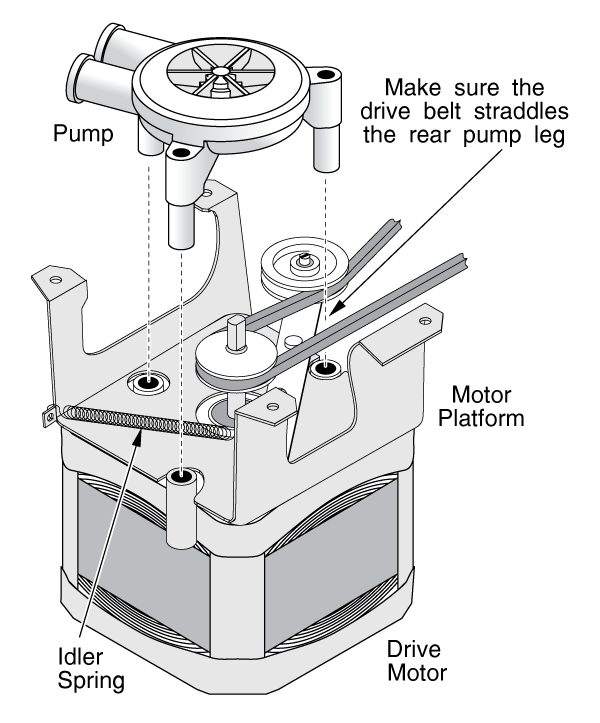
Remove the screws mounting the pump to the motor. Sometimes the pump can get siezed upward pretty good on the motor shaft and make the pump hard to remove. Practice not whack it; steady firm musclepower will get information technology off. Jerk it just a footling if you must.
When you lot put the new pump back on the motor, make sure the belt goes around the pulley and straddles the rear pump mounting leg. (Figure SN-five) Attach the motor platform to the baseplate using the four motor mounting screws. Make sure the belt is positioned inside the idler, and slip the belt around the transmission caster. Then connect the hoses and motor wiring harness.
viii-5 AGITATOR ATTACHMENT: Drive BLOCK OR Drive Bell
Please note that 2 different methods were used to mount the agitator in these machines. Please read this entire section and determine which you lot accept before trying to remove the anarchist, or you may damage the machine, or even yourself!
Early 2-BELT "LONG-SHAFT" MACHINES
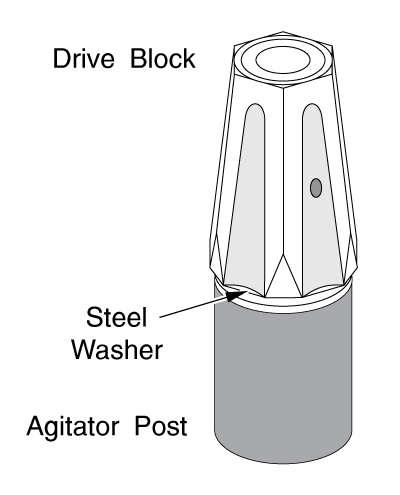
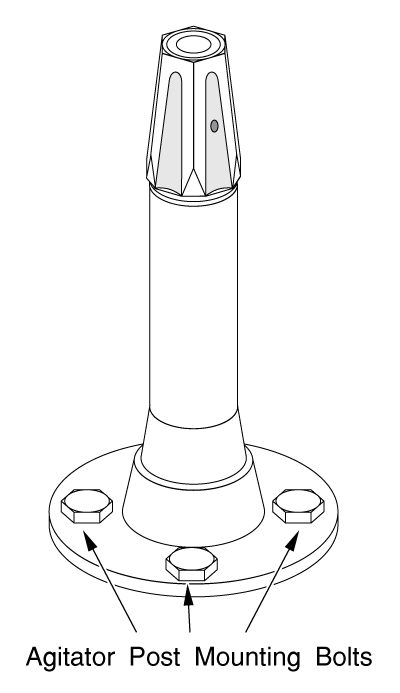
The early two-belt machines had an anarchist postal service and drive block. (figure SN-6) In these, you remove the agitator by unscrewing the concur downwardly cap and lifting it out. Y'all must remove the whole agitator post to get out the agitator shaft and drive block. (Figure SN-7) Remove the four bolts at the base of the agitator mail service and lift out the postal service. A circlip on the bottom of it holds the shaft in place. Remove it and the shaft will slide out of the post. Be careful not to damage the water seal within the postal service when removing or installing the shaft.
When installing the post, be sure to use a new base of operations gasket; it is ane of the seals that keeps water abroad from the top of the transmission.
Figure SN-half-dozen: Drive Block (Long Shaft Machines)
Effigy SN-7: Agitator Post
Bulldoze Bong OR "Brusque SHAFT" MACHINES
In later machines, the agitator simply snaps onto a "drive bell." There is no screw cap holding the agitator on in these machines. To remove this agitator, the factory recommends a special tool. I take found it just as easy to take your belt off, slip it effectually the underside of the anarchist and tug sharply upward on the belt. (If you lot're thick enough, like me!) (Figure SN-viii) Position the chugalug beneath the agitator vanes to avoid breaking the agitator. Be careful when you lot do this, or the agitator may hitting you lot in the face when it pops off!
Figure SN-8: Agitator Removal and Drive Bell
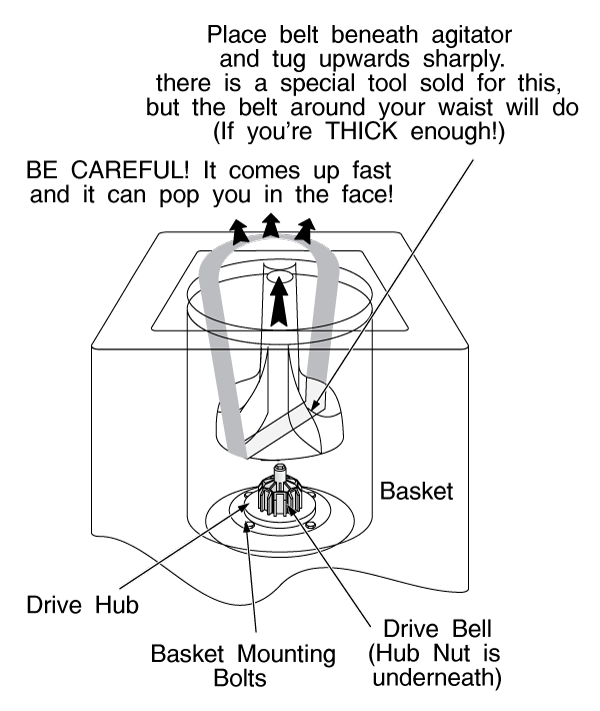
Once y'all've got the agitator off, you'll encounter the small plastic bulldoze bell. (figure SN-viii) This drive bong serves a couple of different functions. It connects the agitator to the agitator shaft of the transmission. It also traps air beneath it and keeps h2o abroad from the seal and out of the transmission. There is an "O"-ring around the drive bong mounting screw, and/or a rubber plug that plugs the top of the drive bong, that seals the air within the drive bell. It is critically of import that this "O"-band or plug exist in good condition or water will become into the transmission and ruin it. Whenever you remove the drive bell spiral, supervene upon the "O"-ring or plug.
Once you remove the mounting screw, the drive bell can exist difficult to get off. If you can't get it off by manus, you have a couple of options. The factory sells a special puller; however, since a new drive bong comes with the seal kit, I've institute that it's cheaper and easier to chisel off the erstwhile bulldoze bell. With a common cold chisel, but cut ii slots forth the hub of the bulldoze bell to loosen it from the splined shaft below. Be conscientious not to chisel anywhere almost the screw threads, or you might harm them.
Beneath the drive bong is a water seal. To remove it, pry up on the bottom of this seal with a screwdriver. The manufactory has a special tool to install it evenly, but if you're careful, you lot tin can do it by hand. Use some liquid dishsoap to lubricate information technology. The new seal kit comes with pretty thorough instructions.
eight-6 Handbasket REMOVAL AND TUB WATER SEAL REPLACEMENT
If you lot are replacing the tub water seal, make sure you get the upper seal kit and supervene upon it, too. Information technology may be included with the lower seal kit; but make sure it'south there.
First, remove the agitator and anarchist post assembly, or the drive bong and seal, as described in department viii-5. Using a screwdriver, popular the tub band clips holding the plastic tub ring to the top of the tub, slowly lifting up on the tub ring as you work your way around it. Remove the tub band. Notation the locator tabs in the band and slots in the tub for reinstallation. Always replace the tub band gasket; information technology should exist included in your new seal kit.
If you merely desire to cheque the tub fittings, remove the four (or viii) handbasket bolts holding the basket to the drive hub and lift out the basket. Practise not remove the hub nut.
If you are replacing the tub water seal, you will need to remove the bulldoze hub. The hub is held onto the elevation of the transmission casing past either a hex nut or a spanner nut. Some have locking tabs you lot must bend out of the style starting time. You lot should and so exist able to turn the nut. There is a spanner available for this, but you can use a pipage wrench. Only be extra careful not to booger the threads with the pipe wrench; these threads are cutting into the superlative of the manual casing, and you don't want to take to purchase a new manual.
The water seal is beneath the drive hub. Notation carefully the order and orientation in which things come off; there are some models out at that place with an parts that are slightly different than shown in Effigy SN-9. Always supersede used gaskets or seals.
Figure SN-9 Bulldoze Bong, Bulldoze Hub and Seals
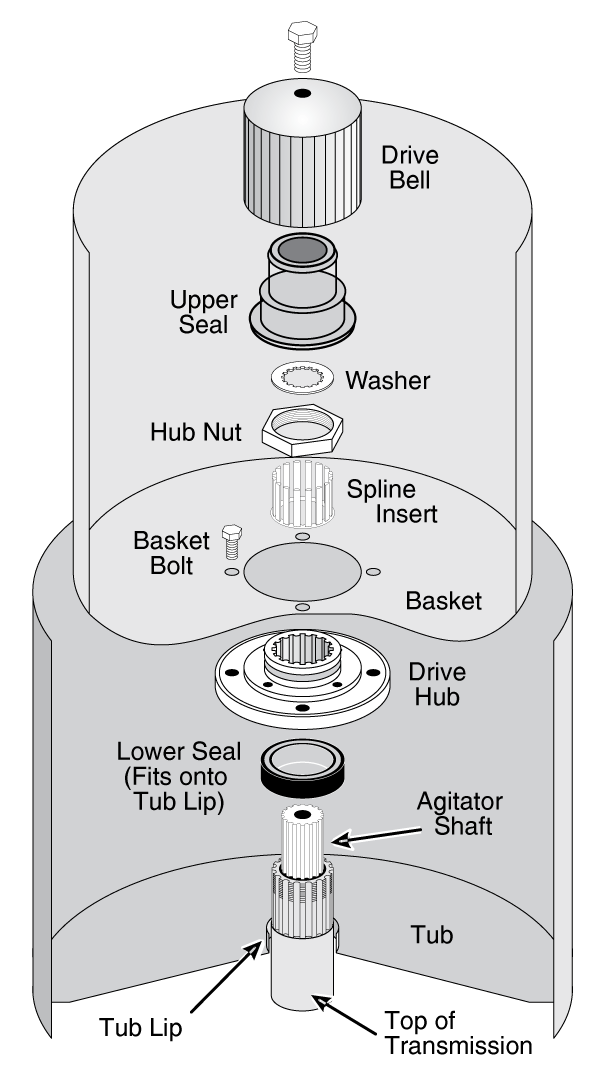
There are a couple of surfaces to put sealant and lubricant on in replacing the water seal; the seal kit contains these. At that place is also a spline insert and a stainless steel sleeve to get in the right place. (The fingers of the spline insert point upwards!) The new hub and seal kit for your motorcar comes with instructions for installing the seal; follow them carefully.
8-seven BRAKE AND Manual SERVICE
If you lot just need to replace the restriction pads, it is possible (but difficult!) to do then without removing the module from the automobile. The problem is holding the manual and getting a good grip on and turning the pulley at the aforementioned time; once the restriction starts to release, the transmission will be gratis to plough. Then once y'all get the brake released, the problem becomes belongings it in that position while you replace the brake pads. If yous're going to effort, brand sure you remove the motor platform first to become more room to work.
If yous demand to supercede the transmission or brake disk assembly, or the upper or lower bearings, you will need to remove the tub and transmission module.
To do this, first remove the launder basket, hub and tub water seal as described in previous sections.
Mark the front side of the tub with a slice of tape, so that y'all tin reinstall it more than easily. Remove the two forepart levelling springs by unhooking them from the tub. The factory sells a tool for releasing the springs, merely you tin fashion one out of a coathanger, or simply remove i of the front end springs and utilize the hook on it to remove the other springs.
When you've got the springs off, disconnect the force per unit area hose from behind the tub. Stone the tub forward and out of the machine and flip the module upside down.
(Note: Practise NOT lubricate the pin friction pads! Any lubrication on the friction pads will cause the car to trip the out-of-remainder switch as well hands!)
Disassembly of the module is pretty straightforward; see figure SN-10. However, there are one or two tips and tricks:
Figure SN-10 Module Associates
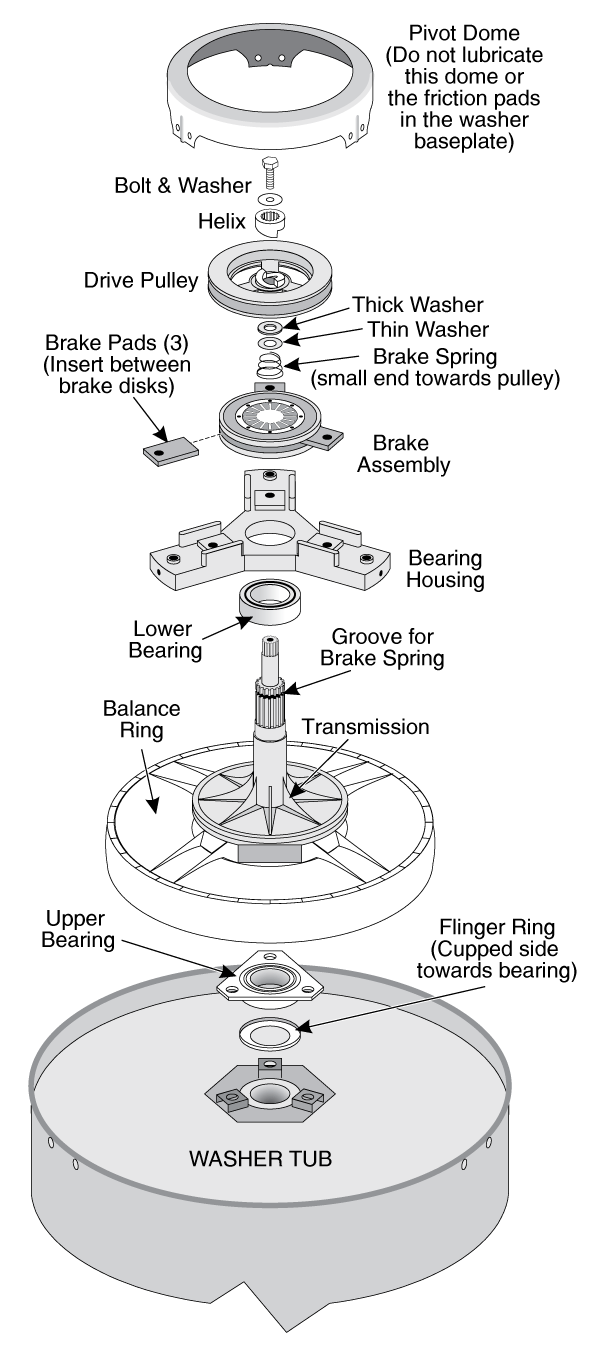
The brake jump must be seated in the notch in the transmission casing. The manufactory makes a special tool for this; withal, it is possible (merely difficult) to get the spring on with a couple of flat-bladed screwdrivers. It's your telephone call. I say purchase the tool if it'due south available.
Coat all transmission surfaces that contact the upper and lower bearings with an anti-sieze compound. Make certain you marking the position of the balancing ring when you remove it from the transmission, and so that you lot can get information technology back on the new transmission in the same way.
Annotation: Module assembly is pictured upside-down; this is the fashion you will have it when disassembling it!
Besides NOTE:
In that location were many dissimilar washing machine models made of this basic pattern! Some had variations of the parts you lot see hither. For example, in some before models, a needle bearing was used in place of the thick and thin washers. In others, a cup-shaped drive pulley was used. When disassembling, Note carefully the order and orientation of the parts you remove (draw pictures or take notes if you must!) and so yous tin can get them dorsum on the same way.
Delight share our .

Source: https://www.appliancerepair.net/washing-machine-repair-8.html
Posted by: austinsarued.blogspot.com
0 Response to "How To Clean My Speed Queen Washing Machine"
Post a Comment